






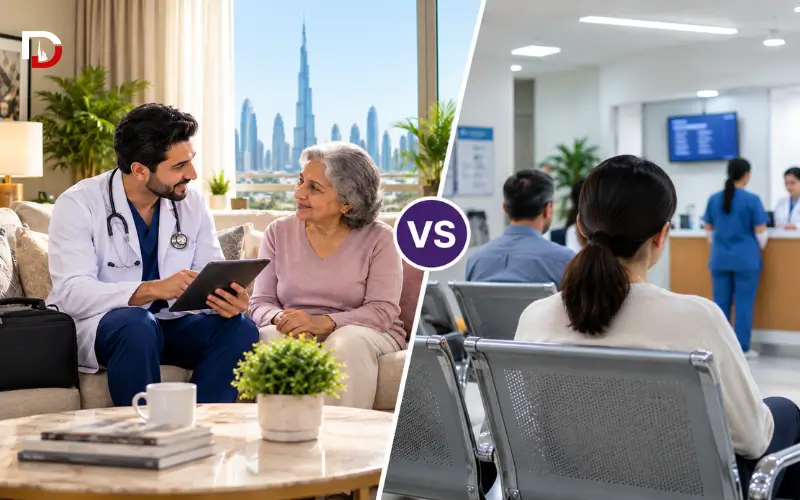
It is 9 p.m. on Thursday, and your throat feels like sandpaper. The nearest clinic will close in ten minutes—it would take thirty minutes to get there, and you are not sure whether going would be worth it. Many Dubai residents now ask a different question first: would it be easier to have a doctor on call come to them, so they can stay exactly where they are? Both options have a place, and the right one depends on what is wrong, how urgent it is, and what you need to find out.
The short answer is that a home visit suits common, non-critical problems and anyone for whom travelling or waiting is a burden. A clinic is better when you need imaging, a specialist procedure, or a long-term relationship with one doctor. Here is how to tell which fits your situation.
How Each Option Works
The Clinic Visit
You book or walk in, travel to the clinic, wait, and see a doctor who has equipment on site. For vaccinations, annual check-ups, and follow-ups with a doctor who already knows your history, that structure works well.
The Home Visit
In Dubai, a doctor can be sent to your location following a phone call or an online booking. A coordinator will ask about your symptoms to make an immediate assessment, and a licensed physician will arrive equipped with a portable medical kit to conduct an examination, provide a diagnosis, and administer treatment. Many home-visit medical services also facilitate additional care, such as visits from nurses, blood sample collection, and the administration of IV fluids.
Where a Home Visit Wins
Time and Convenience
A clinic trip often takes a large part of a morning or afternoon once travel, parking, and waiting are counted. A home visit removes most of that, which matters for parents juggling children and for professionals who cannot lose half a day.
Comfort and Infection Risk
A person suffering from a fever, an upset stomach, or a migraine rarely feels comfortable in a crowded waiting room. At home, they can rest in bed, which also prevents others from being exposed to germs. Children, too, remain calmer in a familiar environment, making it easier to examine them. For the elderly, avoiding the strain of travel and long waits can be just as important as the medical treatment itself.
Out-of-Hours Access
Illness does not adhere to business hours. Many clinics remain closed late at night, on weekends, and during public holidays, leaving emergency departments as the only alternative. For medical issues that require immediate attention but are not life-threatening, a doctor’s home visit bridges this gap.
Privacy for Sensitive Tests
Some tests are simply easier to do away from a waiting room. An HIV test at home or an STD test at home lets a trained professional collect the sample discreetly, without a reception desk or the worry of being seen. Results are shared privately, and a doctor can explain them and arrange confirmatory testing or treatment if anything needs follow-up.
Where a Clinic Still Makes Sense
Equipment and Imaging
X-rays, CT scans, and MRI need facility-grade equipment. If a doctor suspects a fracture or a deeper problem, you will need a clinic or hospital no matter where the first consultation took place.
Specialists and Procedures
Dental care, dermatology procedures, minor surgery, and specialist consultations generally happen in a clinic. A home visit can still start the process by assessing you and referring you onward.
Long-Term Continuity
If you have a chronic condition and a trusted family doctor who knows your history, regular clinic visits support that relationship. Some home providers keep records and arrange follow-ups, but it is worth asking before you rely on them for ongoing care.
What to Expect During a Home Visit
If you have never booked one, the process is simpler than most people imagine. You call or book online and describe your symptoms. A coordinator checks how urgent the case is and sends the nearest available physician, who in central areas can often arrive within 30 to 60 minutes.
Following this, the examination process proceeds in a set sequence: a review of your symptoms and medical history, a physical examination, and as needed checks of your temperature, blood pressure, and oxygen levels. The doctor explains the diagnosis, prescribes medication if necessary, and informs you of specific warning signs that should prompt a return to the hospital. By the end of the visit, you should have written notes; these documents are valuable for insurance claims and for any future consultations with a medical specialist.
Cost and Insurance
Fees vary by provider and by time of day. Home visits usually include a call-out charge, while a clinic consultation can look cheaper on paper until you add travel and lost time. Insurance coverage for home visits differs between policies, so check with your insurer and ask the provider to state fees before the visit. Comparing the total cost of each route, rather than the consultation fee alone, gives a fairer picture.
Three Real-Life Scenarios
The Working Parent
A child spikes a fever at 8 p.m. while a second child is already asleep. Leaving the house means waking both and sitting in a waiting room. A home visit lets the doctor examine the child in bed, prescribe treatment, and explain what to watch overnight, without anyone leaving the apartment.
The Visitor With a Stomach Bug
On the second day of their trip, a traveler wakes up suffering from dehydration and nausea. They are unaware of local clinics—or which ones might accept their travel insurance. This is where a hotel doctor proves invaluable: a physician can visit the room to examine the traveler, advise on necessary fluids and medication, and provide the documentation required by their insurance provider.
The Twisted Ankle
After a fall during a weekend run, an ankle swells badly and cannot take weight. This is a case where a clinic or hospital is the better first stop, because ruling out a fracture needs an X-ray. A home visit would only add a step.
How to Decide
Choose a Home Visit If
Your symptoms are common and non-critical, such as fever, flu, stomach upset, or a minor infection. The patient is a young child, an older adult, or has limited mobility. It is outside clinic hours. Or you want blood tests and follow-up care arranged in one place. In each case, a doctor at your home can often start treatment within the hour.
Choose a Clinic If
You need imaging or a procedure, you are seeing a specialist, or you want a routine check-up with a doctor who knows your history.
Go Straight to Hospital If
You are experiencing symptoms such as chest pain, severe difficulty breathing, signs of a stroke, seizures, heavy bleeding, or loss of consciousness. In such a situation, you need an ambulance not an appointment.
Check the Provider First
Regardless of the method you choose, verify that the service provider is licensed by the Dubai Health Authority (DHA). Ask about their expected arrival time, and ensure that you will be provided with written instructions and prescriptions. Reputable providers will answer these questions readily. Additionally, it is helpful to have the contact number of a reliable service provider saved in advance, as trying to select a service in the middle of the night—especially while suffering from a fever is rarely an ideal situation.
Also Explore: Prayer Times in UAE
The Bottom Line
It is rarely an “either-or” choice. Many residents utilize both options, relying on a clinic for routine care while opting for a home visit when illness strikes at an inconvenient time. For visitors, having a hotel doctor eliminates the stress of searching for an unfamiliar clinic while feeling unwell. For everyone else, the decision comes down to urgency, the need for specific medical equipment, and convenience; knowing which option applies to your situation before the need actually arises makes the decision much easier.