






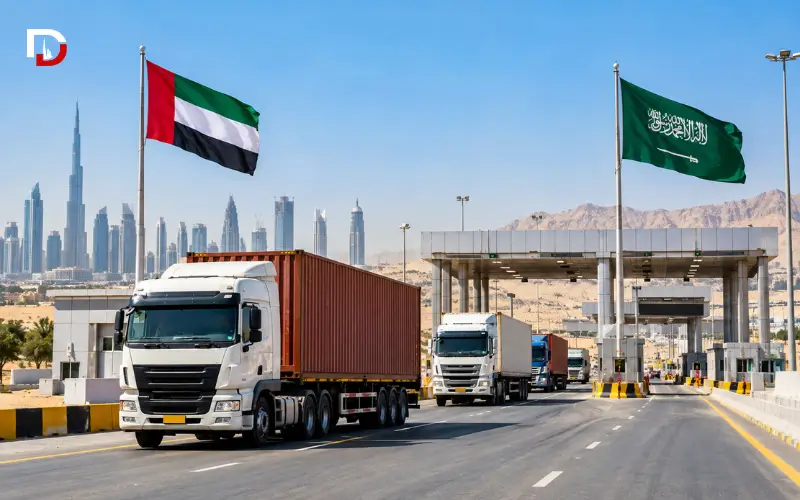
The UAE and Saudi Arabia are two of the critical commercial markets in the Gulf, making the corridor a very active logistical route for companies transporting goods, equipment, and supplies around the region.
Saudi Arabia is a major market for expansion and distribution for businesses in the UAE. The UAE’s ports, airports, free zones, warehouses, and existing logistics infrastructure also render the country an important gateway for goods to flow into the broader GCC region at the same time.
But logistics between the two countries are far more complex than logistics arrangements. Businesses must take into account the type of product, documentation, customs, packaging, shipping costs, and delivery requirements before a shipment leaves a company’s warehouse.
With a well-designed logistics process, businesses can minimize unnecessary delays and create a more dependable cross-border supply chain.
Why the UAE–Saudi Trade Corridor Matters
The UAE as a Regional Distribution Hub
The UAE has become an important distribution hub that links manufacturers and suppliers from Asia, Africa, Europe, and other countries with customers in the Middle East.
Any goods that enter the United Arab Emirates via ports and airports can be stored, processed, consolidated, or redistributed before being shipped to another GCC country.
Saudi Arabia as a Key Destination Market
Many such shipments originate in Saudi Arabia and are shipped to the large domestic market in the country. This puts pressure on logistics within various sectors, such as retail, automotive, construction, manufacturing, e-commerce, electronics, furniture, machinery, and general trading.
Indeed, when entering the Saudi market, companies have to consider logistics when they are thinking about expansion; shipping is not an individual operation.
Road Freight Plays a Major Role
Vehicle and Freight Options
Road transport is of critical importance in cross-border trade between the UAE and Saudi Arabia due to the direct land border. Different vehicle types and ways of transporting freight can be utilized based on the shipment.
Large shipments might need special trucks, and sometimes smaller ones can be combined with other freight. Depending on the size, weight, temperature, and physical properties of the goods, there may be special vehicles needed.
Road freight can also be flexible when businesses need to pick up from the warehouse in the UAE and drop off at a particular point in Saudi Arabia.
Coordination Across the Journey
But there needs to be coordination for efficient road freight.
Pickup times, sorting the goods, paperwork, border controls, customs clearance, and final delivery are all part of the process. If any of the following stages are delayed, it will impact the delivery schedule.
Choosing Between Road, Air, and Sea Freight
Road Is Not Always the Answer
While this trade route may be heavily trafficked via road, it isn’t necessarily the best option for all shipments.
When Air Freight Makes Sense
Air freight can be useful when speed has a high commercial value. When the part or sample is urgent, or when there is a rush to ship valuable items or products to meet a deadline, air transport may be the better option for the extra cost.
When Sea Freight Is an Option
Meanwhile, if there is a broad supply chain linked to port facilities, sea freight may be a consideration for certain high-volume or containerized shipments.
Choosing Based on the Specific Shipment
Rather than focusing on which is usually the cheapest or fastest way to ship, businesses need to consider which method makes the most sense for that particular shipment.
It should take into account cargo volume, weight, urgency, the value of the cargo, origin and destination, handling requirements, and budget.
Documentation Should Be Prepared Before Dispatch
Required Documents
One of the areas where thinking ahead can help is the documentation. Commercial shipments may require a commercial invoice, packing list, certificate of origin, transportation documents, and other supporting documentation. There may also be certificates, permits, registration, or approvals needed for certain categories of products. Specifications may vary according to the type of goods and import procedure.
Therefore, it is advisable for businesses to check requirements in advance and not at the border or customs clearance.
Accuracy Is Equally Important
Accuracy is also important.
Product description, quantity, value, country of origin, and other shipment details should be well documented. Inconsistencies can lead to a lot of questions during clearance.
Customs Is Part of the Logistics Strategy
Plan Customs Early
Sometimes, customs clearance is perceived as a bureaucratic process done at the tail end of the transport planning process. In fact, it should be taken into account much sooner.
Businesses need to be aware of product classification, documentation needs, whether any special approvals will apply, and any costs of importing the goods.
Shipping to Saudi Arabia for the First Time
Shipping companies shipping for the first time to Saudi Arabia will consider this aspect to be particularly important.
This preparation is even more critical when shipments include several product categories or product(s) that have other regulatory requirements.
Reviewing the available options for UAE to Saudi Arabia cargo shipping and understanding the logistics process before dispatch can help businesses identify transportation and documentation requirements early.
Packaging Is a Logistics Decision
Packaging for the Complete Journey
Packaging can be considered mainly to reduce damage, but it can also have an impact on transportation efficiency and cost.
Commercial goods can transit warehouses, loading stations, trucks, customs stations, a nd delivery stations before being delivered to the end user. It is, therefore, imperative that packaging should be appropriate for the whole journey.
Fragile products may need additional cushioning within and improved packaging around the product. Products that are heavier might require pallets or other special methods of securing the product. Protection against impact and scratching may be necessary for furniture and finished surfaces.
Avoiding Excessive Shipment Size
Meanwhile, unneeded packaging can result in larger shipment sizes.
Freight rates may depend on weight and volume, so packaging should be designed to ensure protection, but not so much that it results in an oversized shipment.
Understanding the Full Cost of Shipping
Looking Beyond the Headline Rate
When comparing freight quotations, companies shouldn’t consider the headline transportation rate. Final logistics costs may include collection, packing, loading, freight, customs services, storage, special handling, and delivery to the end user.
Shipment Characteristics Matter
The characteristics of the shipment are also relevant. The requirements for a small commercial shipment from Dubai to Riyadh will be different from those of heavy equipment moving from Abu Dhabi to another project site in Saudi Arabia.
Information Needed for an Accurate Quotation
When requesting a price quote, logistics suppliers need to have detailed information so as to more accurately calculate the cost. Items that are helpful are cargo type, number of packages, size, weight, collection address, delivery address, and special handling instructions. To create a More Predictable Supply Chain.
Building a More Predictable Supply Chain
Standardizing the Process
In the case of occasional shipping companies, every shipment is a single project to handle. However, businesses that do frequent business between the UAE and Saudi Arabia can take advantage of a more streamlined process.
This could involve standardizing documentation processes, packaging codes, delivery timing, internal authorization flows, and roles and responsibilities among the supplier, logistics service provider, and customer.
Learning from Previous Shipments
Having the history of past deliveries can also be useful in pinpointing any recurring delays or unnecessary costs. They can improve transportation over time and enable companies to make accurate and confident inventory and customer delivery plans.
Logistics as Part of GCC Business Growth
Expanding into another Gulf market involves more than finding customers. Businesses also need an operational structure capable of moving products reliably across borders.
For companies trading between the UAE and Saudi Arabia, transportation planning, customs preparation, documentation, packaging, and delivery should work as connected parts of the same process. The most effective logistics decisions are usually made before the cargo starts moving.
By understanding shipment requirements early and selecting transportation based on the actual needs of the goods, companies can build a more efficient cross-border operation and support sustainable growth across the GCC.
Must Explore: Electra Park
Conclusion
Cross-border logistics between the UAE and Saudi Arabia is about much more than moving cargo from one point to another. Choosing the right mode of transport, preparing accurate documentation, planning for customs, packaging goods properly, and understanding the full cost of shipping all shape how smoothly a shipment reaches its destination.
Businesses that treat these elements as part of one connected process and plan them before dispatch are better placed to avoid delays, control costs, and deliver reliably to their customers. For any company looking to grow across the GCC, a well-organized logistics approach is a practical foundation for long-term success in the UAE–Saudi trade corridor.