






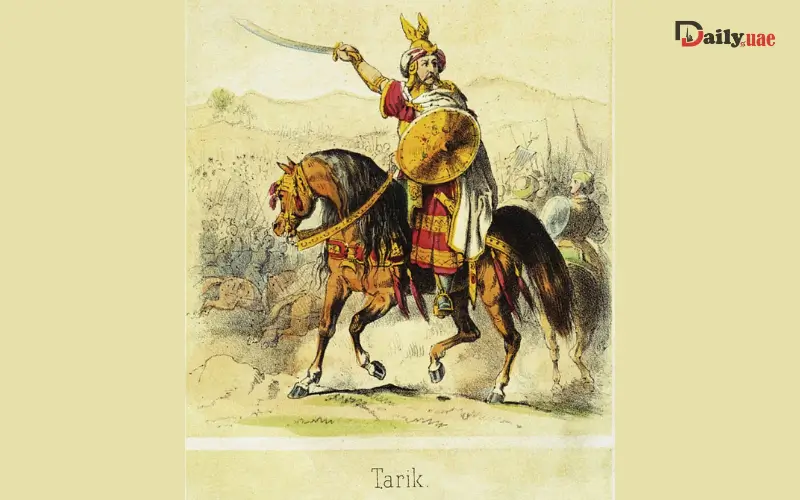
On the very edge of Europe in April 711 CE, a Berber general stood atop a rocky mountain, orchestrating the world-changing event which was about to unfold. Tariq ibn Ziyad was his name. He was outnumbered by the Visigoths by more than 100,000 soldiers and only had a few thousand soldiers on hand to defend himself. There was no way for him to escape. He was said to have been in the process of destroying the ships that were behind him.
What unfolded then was one of the most phenomenal military campaigns in history, the conquest by the Muslims of the Iberian Peninsula (Spain and Portugal today). That rocky mountain that he fell on? To this day, it goes by his name: Jabal Tariq Gibraltar. More than a millennium and a half later (2026), Tariq ibn Ziyad is still a topic of significant conversation in Islamic history and continues to be taught in schools all over the UAE, Pakistan, Morocco and other Islamic countries.
Quick Facts: Tariq ibn Ziyad
| Field | Details |
|---|---|
| Full Name | Tariq ibn Ziyad ibn Abdullah |
| Born | c. 670 CE, Tlemcen region, present-day Algeria |
| Died | c. 720 CE, Damascus, Umayyad Caliphate |
| Origin | Berber (Nafza tribe), North Africa |
| Religion | Islam (convert) |
| Role | Umayyad military commander, Governor of Tangier |
| Famous For | Muslim conquest of the Iberian Peninsula (711 CE) |
| Key Battle | Battle of Guadalete, July 711 CE |
| Gibraltar Name | Jabal Tariq (Mountain of Tariq) — named after him |
| Army Size | 7,000 (later reinforced to 12,000) |
| Al-Andalus Rule | Muslim rule in Iberia lasted ~800 years after its conquest |
Who was Tariq ibn Ziyad?
Tariq ibn Ziyad was a Berber military commander during the early 8th century for the Umayyad Caliphate. He was born in the vicinity of the present-day town of Tlemcen in Algeria in about 670 CE, and came into prominence as one of the most important generals ever. As per the historian, Ibn Khaldun was from a tribe named Nafza, which is Berbers from the North African region.
In the Arabic sources, he is often called the freed slave (mawla) of Musa ibn Nusayr, the governor of North Africa for the Ummayyad dynasty. An adventure narrative accounting for this thought has been written (EBSCO Research Starters, 2024), but whether his story was actually one of slavery or merely of being a loyal subordinate in the Arab-Berber tribal sense is still not clear with modern historians. There is no doubt that Tariq was not an Arab by birth, but rather a Berber (as was Prophet Muhammad himself), a new Muslim convert, and ascended to be the leader of one of the greatest military campaigns in Umayyad history.
Shortly after 708 CE, Tariq was appointed Governor of Tangier, a strategic city in Morocco overlooking the Strait of Gibraltar, by Musa ibn Nusayr. For it was at Tangier that Tariq would lay the groundwork for an operation he would become better known by means of which he would conquer the world from ‘Christian communities’ and establish the Islamic empire in its stead.
Tariq ibn Ziyad was a Berber warrior and a Muslim convert appointed Governor of Tangier in 708 CE. He was of North African (Nafza) descent and had served the loyalty of Musa bin Nusayr of the Umayyad Caliphate in the navy.
Origins and Ancestry: Arab, Berber, or Persian?
A point that is much discussed about Tariq ibn Ziyad is his actual ethnic background. The medieval historians give conflicting accounts, and the situation remains unclear at this point in the year 2026.
The Berber Claim
Most Muslim historians believe that Tariq was a Berber. According to Al-Marrakushi, the majority of scholars attribute him, a Moroccan, to the tribe of the Nafza, who are Berber people. According to Ibn Khaldun, his own tribe were settled between the two banks of the Tafna river in Tlemcen, Algeria (Ibn Khaldun, Muqaddimah). Historian Heinrich Barth also gives him as the Ulhassa descent Berber.
The Arab and Persian Claims
At times, such as in some Arabic accounts by Ibn Khaldun, Tariq is attributed to a known Arab tribe, the Banu Layth. However, other accounts (minority views) are for Persian descent. The entire genealogy, sometimes provided – Tariq ibn Ziyad ibn Abdullah ibn Rafiho ibn Warfajum ibn Yanzaghasan ibn Walahas ibn Yatufat ibn Nafzaw is an amalgamation of Berber and Arab style names, illustrating the social melting pot of the time.
The importance of the idea is that the early period of Muslims’ acquisition of lands is an expression of the spread of Islam in general, for within these decades after the Prophet was born, members of vastly different ethnicities fought for Islam side by side – Berbers, Arabs, Persians, Yemenis. Tariq rose to be an historic figure because he spoke with a voice different from that of the Arab commanders – he was a proud non-Arab Muslim with a fighting voice.
Based on the evidence from history, the best conclusion that can be drawn is that Tariq ibn Ziyad was of Berber heritage, specifically from the tribe Nafza in modern-day Algeria. His origins are unclear because although he was not Arab, he ascended to command a significant Umayyad campaign, rising to a position of great social mobility in early Islamic society.
Why Did Tariq ibn Ziyad Invade Spain?
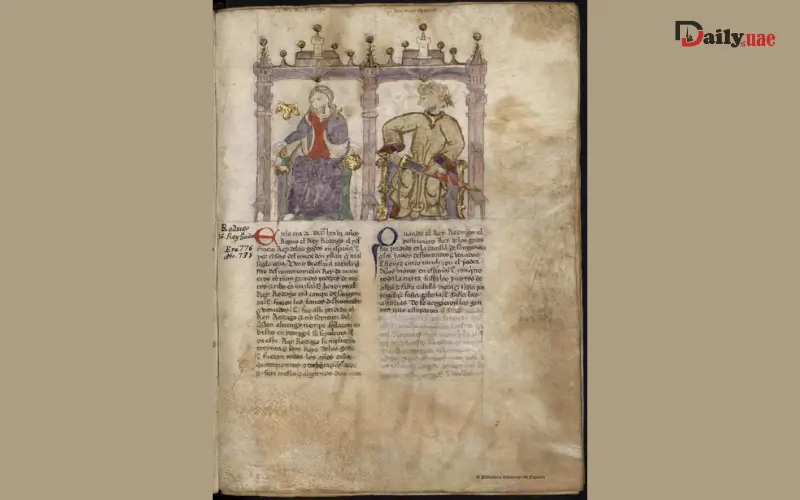
It is essential to grasp the situation of a political vacuum in the early 8th century on the Iberian Peninsula, if one is to understand the conquest of Iberia. For centuries, the Iberian Peninsula had been under the Iberian on the Iberian Peninsula the Visigoths, a Germanic kingdom. Finally, the kingdom was divided by 710 CE.
The Visigothic Civil War
After the death of King Witiza, c. 710, he was succeeded by a man named Roderic or Ludhriq (have you forgotten what a politician is?) who politically seized the throne and finished off Witiza’s sons. The King’s sons refused to accept what had been given to them; they sent a letter to the army of the Muslims of North Africa under the leadership of Musa ibn Nusayr asking for assistance.
Count Julian and the Alliance
An important facilitator was the ruler of Ceuta (Sabtah), the nearest stronghold to North Africa, Count Julian. According to some historic accounts, including that of Ibn Abd al-Hakam, Julian had personal complaints against King Roderic. He was able to provide the Muslim army with something they needed: ships to cross the Strait of Gibraltar, intelligence, and local information and assistance. Julian then contacted Tariq, promising him assistance in return for some Muslim opposition to Roderic’s rule.
The Reconnaissance Mission
Having decided to take an army, Musa ibn Nusayr sent Tarif ibn Malik on a scouting mission to see what kind of reception he could expect. In 710 C.E., Tarif arrived at the Spanish coast at a port now named Tarifa, which is still his namesake. The mission confirmed the times of Spain’s military weakness and that there was local support. Musa decides to permit Tariq to head the main invasion.
Muslim conquest of Spain: The civil war among the Visigoths after the death of King Witiza kicked off the Muslim conquest of Spain. The sons of Witiza and of Count Julian of Ceuta had both appealed to the Muslims for help. In 711 C.E., after a successful reconnaissance by Tarif ibn Malik, Tariq ibn Ziyad was asked to lead the main campaign.
Must Read: Ousha Al Suwaidi Biography
The Crossing of Gibraltar: April 711 CE
In approx. 711 CE (5th Rajab 92 AH) Tariq ibn Ziyad crossed the Strait of Gibraltar with an army of some 7000 men, mainly Berber Muslim converts, along with a few Arab troops. Count Julian’s ships brought the army down to the end of a great rock in front of them.
Tariq settled here to establish his base camp, which eventually came to be known by his name forever: The Jabal Tariq (in English, the Gibraltar) Mountain of Tariq. In historic records written by the Muslim community, it is stated that Tariq created a small castle near the rock to use it as a military springboard, and he appointed guards to protect his rear lines. This was a very strategic plan, commented on by modern-day military history specialists (IslamWeb, 2024).
Did Tariq ibn Ziyad Really Burn the Ships?
Perhaps most well-known of Tariq’s story and one of the least understood was the iconic actor’s appearance. One of the most iconic moments of Tariq’s story, and something he perhaps told his schoolmates the least, was that of the large-scale appearance of a famous actor. We’re told that when Tariq landed, he burned his ships before him so they wouldn’t be able to run away and then made a speech encouraging his soldiers to face death or fight.
But this story, as historians point out, has to be investigated critically. The first writing reference to the boat burning comes from passing the fact on, in the 12th-century geographer al-Idrisi, more than 400 years after the incident. No mention of the story can be found in earlier, more reliable sources like al-Baladhuri. The fact that the boat-burning was never actually recorded, as was correctly pointed out by the National (UAE) editorial, does not mean that it does not represent, in the eyes of the modern reader, a metaphor, a shadowy scene of a past event or events, rather than a literal historical reality.
The Khutbah of Tariq (speech supposedly delivered by him according to 13th century historian Ibn Khallkan and 16th century historian al-Maqqari) has been more extensively documented. The primary idea behind it: THE ENEMY IS BEFORE YOU, THE SEA BEHIND YOU, FIGHT FOR HIS CAUSE, OR VICTORY, OR MARTYRDOM. THERE IS NO THIRD OPTION.
Verdict: It seems as though the legend of the burning boat is probably centuries old. This powerful speech proved to be historically accurate, as later medieval Arab historians confirmed it, but not contemporary historians. The larger strategy of doing away with the “mindset of retreat” was as much in effect as the actual burning of boats.
The Battle of Guadalete: July 711 CE
On hearing of the Muslim landing, King Roderic gathered a huge host — estimated by historians at 100,000, though modern historians suggest that was an overestimate. Tariq asked for reinforcements from Musa ibn Nusayr, who dispatched 5,000 more Arab riders to help Tariq, and Tariq’s force reached about 12,000 men.
The final battle had been fought between the Muslims and the Spaniards near the Guadalete River, near the modern town of Medina-Sidonia, in the area of Southern Spain, in July 711 CE (Ramadan 92 AH). This conflict continued for eight days in a row. There were several things which went in Tariq’s favour:
- Roderic’s army was split over the question — many of the soldiers were more interested in Witiza’s sons than in Roderic.
- Spanning a large region of Spain, Jews had long been persecuted by the Visigoths and supplied the Muslims with local intelligence and assistance.
- King Roderic was treated with hostility by Christians who favoured Witiza’s sons.
- Tariq’s men were spirited, had faith and were strategically better organised.
According to most sources (Al Mujtama Magazine, 2024), King Roderic was slain in the final battle and drowned trying to cross the river of the Spanish الأمة. The Visigothic army was defeated.
Afterwards, in July 711, the Battle of Guadalete was the pivotal battle that concluded the rule of the Visigoths in Iberia. The smaller but more cohesive Tariq defeated ppolitically dividedRoderic. The battle would go on for eight days, and by the time it was finished, Roderic had been killed, and Spain was open to the advance of the Muslims.
The Conquest of Iberia: From Gibraltar to Toledo
After winning at Guadalete, Tariq didn’t stop. He divided his troops into four divisions and proceeded to attack the peninsula swiftly:
- One party of Mughith al-Rumi took the city of Cordoba.
- A second division took Granada! Another division was captured!
- Tariq personally commanded the division that was able to gain Toledo, the Visigothic capital.
- Further advances were made to the north into Guadalajara and Astorga.
In just a few months, two-thirds of the Iberian Peninsula became Muslim. Meanwhile, Tarik was acting governor of Hispania until June 712CE. Hewas succeeded by 18000 more troops led by Musa ibn Nusayr to carry on the conquest. They together made conquests in the regions of Zaragoza, Tarragona and Barcelona, and received instructions from Caliph al-Walid I to go back to Damascus.
From Guadalete, Tariq was able to quickly conquer Cordoba, Granada and Toledo, putting an end to the Visigothic domination of most of Iberia within a few months. In 712 CE, Musa reache,d and they finished the conquest. The outcome of these conflicts would be a Muslim state known as al-Andalus, which would last for around 800 years.
Tariq ibn Ziyad vs Other Great Muslim Commanders
| Commander | Era | Odds | Greatest Achievement | Fate |
|---|---|---|---|---|
| Tariq ibn Ziyad | 711 CE | 7,000 vs 100,000+ | Conquered the Iberian Peninsula in months | Died in obscurity, Damascus |
| Khalid ibn Waleed | 634 CE | Various | Undefeated in 100+ battles | Died peacefully in Homs |
| Muhammad al-Fatih | 1453 CE | 80,000 vs 7,000 | Conquered Constantinople | Died while preparing a new campaign |
| Salahuddin Ayyubi | 1187 CE | Smaller vs Crusaders | Recaptured Jerusalem | Died in Damascus, 1193 CE |
What sets Tariq ibn Ziyad apart from the elite company is a double advantage – the numerical one and the terrain one – as well as total strategic success, which all came within the course of a single campaign season. Led 7000 men in the conquest of a whole country. None of the commanders in this list had that many victories for their losses.
The Fall of Tariq ibn Ziyad: From Hero to Obscurity
Tariq ibn Ziyad’s tale has an enchantingly ironic conclusion. The man who conquered a whole country for the Umayyad Caliphate was overthrown and forgotten, largely by the government he served so well.
The Conflict with Musa ibn Nusayr
From the point of view of the Arabic historical sources, there is a gradual increase in the bad blood between Tariq and Musa among the commanders. The Arabic historical sources record f rising tensions between Tariq and Musa, the commander. There are a number of testimonies that Musa was envious and troubled by the idea that his freed client had conquered an entire country, and his achievements were remarkable. Early historian al-Baladhuri claims that Musa wrote him a ‘severe letter’ when he arrived in Spain in 712 CE, and he was only arrested for a short time. The two later became reconciled.
Summoned to Damascus
Both Tariq and Musa were sent back to Damascus in 714 CE and were accused of using money and treasures of the Spanish campaign, even though there was an argument over a legend that a table designed by King Solomon belonged to them. Both men were deprived of the rights of citizenship and politically disenfranchised.
The remaining years of Tariq ibn Ziyad’s life were devoted to idle luxury at the Umayyad court in Damascus, with no power and no role. He died about the year 720 CE, which was just 9 years after his greatest success! His burial place is unknown.
Tariq ibn Ziyad, who had conquered Iberia on behalf of the Umayyad Caliphate, was politically excluded when he returned to Damascus in 714 CE. He lost his seat at court, was charged with financial malfeasance and was buried in unknown obscurity about 720 CE. What happened to him testifies to the complicated and sometimes arbitrary politics of the Umayyad court.
The Legacy of Tariq ibn Ziyad: What He Left Behind
Gibraltar — A Name That Survived 13 Centuries
The monument of Tariq ibn Ziyad can be found at one of the most familiar landmarks on Earth. Since 711 CE, his name has been given to Gibraltar, which means Mountain of Tariq, in Arabic. Gibraltar is still a British Overseas Territory vying for control between the UK and Spain, with about 34,000 people living there as of 2026. Everywhere the name of Gibraltar is uttered in every corner of the worldthere is always a memory of Tariq ibn Ziyad.
Al-Andalus and 800 Years of Muslim Civilisation
The conquest was initiated by Tariq, which directly led to the founding of Al-Andalus, the Islamic state of Iberia in 711 CE and the existence of this state until 1492 CE, nearly 800 years. Under the Cordoba Caliphate, Al-Andalus reached its zenith in its culture, with scholars active in multiple fields of knowledge and study, such as mathematics, astronomy, medicine, and philosophy, throughout the rest of the world. During this time, hundreds of Arabic words sprouted into the Spanish language, such as ‘algebra’ (al-jabr), ‘zero’ (sifr) and ‘admiral’ (amir al-bahr). It is a cultural inheritance that goes right back to the campaign that Tariq started in 711 CE.
A Symbol of Social Mobility in Islam
Tariq’s story has a strong messageino the Muslim culture – that in the name of Islam, things were made equal for everybody, irrespective of ethnic and social differences. An Arab he was, who came from a lower social class, and defeated a continent. The companions of the Prophet Muhammad (PBUH) were all non-Arab, including Bilal ibn Rabah, Salman al-Farsi, and Zaid ibn Harithah; a continued tradition of Islam establishing social mobility that was continued in the 8th century by Tariq ibn Ziyad.
This legacy can be seen in three different ways: ‘Gibraltar’, the city he founded, still honours his name; the 800-year-old Islamic community (al-Andalus), to which he introduced Islam; and the Islamic concept of value and potential is determined by one’s faith and not ethnicity or birth.
You also like:
Asma Hamza | Biography, Music Career, Google Doodle And Legacy
Frequently Asked Questions
Was Tariq ibn Ziyad Arab or Berber?
Tariq ibn Ziyad was Berber, most probably from the tribe Nafza in Algeria today. Was not of Arab descent, but was a convert to Islam and a member of the military of the Umayyads.
Why is Gibraltar named after Tariq ibn Ziyad?
The name Gibraltar is of Arabic origin and is translated as Mountain of Tariq. When his army landed there in April 711 CE, the mountain was named in his honour, and the name has endured ever since.
Did Tariq ibn Ziyad really burn his ships?
It is virtually impossible to believe this now. The earliest written reference was made by the 12th-century geographer al-Idrisi, more than four centuries after the event; it is not, however, recorded in the earlier, much more reliable, historical work.
How many soldiers did Tariq ibn Ziyad have?
Tariq was accompanied by around 7,000 soldiers when he entered Spain. After requesting reinforcements from Musa ibn Nusayr, his army grew to around 12,000 before the Battle of Guadalete.
What was the Battle of Guadalete?
In July 711 CE (8th century), Tariq’s army defeated the army of King Roderic of the Visigoths in an eight-day siege known as the Battle of Guadalete, thus bringing an end to the rule of the Visigoths over the Iberian Peninsula and opening the door to Muslim conquest in Spain.
What happened to Tariq ibn Ziyad after the conquest?
He was recalled to Damascus in 714 CE, and was accused of misappropriating treasure and deprived of power, until dying in obscurity at the court of the Umayyad princes about CE 720.
How long did Muslim rule last in Spain after Tariq?
The Islamic rule of Iberia spanned from 711 CE to 1492 CE (a period of about 781 years) till the defeat of the last Muslim kingdom of Granada by Ferdinand and Isabella of Spain.
What is the Khutbah of Tariq?
The speech given to him before the Battle of Guadalete, where his army had no choice but to fight, is called the Khutbah of Tariq. It was documented by 13th century historianIbn Khallikan and 16th century historian Maqqari.
Why is Tariq ibn Ziyad important in Islamic history?
Forged the way for 800 years of Muslim rule in Al-Andalus (Iberian Peninsula) to Islam. This is one more glimpse of the social mobility Islam provided non-Arab converts during the early Umayyad period.
Where was Tariq ibn Ziyad born?
Historian M. K. Biyaarewala dates his birth between 670 and 690 CE in the Tlemcen area in present-day Algeria, North Africa.
What does Jabal Tariq mean?
Jabal Tariq means Mountain of Tariq in Arabic. The original Arabic name of the Rock of Gibraltar whi, which can be traced back to the time of Tariq ibn Ziyad,d when his army camped there in 711 CE.



2 Comments
Dr. Saniya Habboub Biography | Google Doodle Story 2026
June 30, 2026[…] Read Also: Tariq ibn Ziyad […]
Sheikh Hamdan Biography | Family, Career And Net Worth 2026
June 30, 2026[…] Tariq ibn Ziyad: The Muslim General Who Named Gibraltar […]