




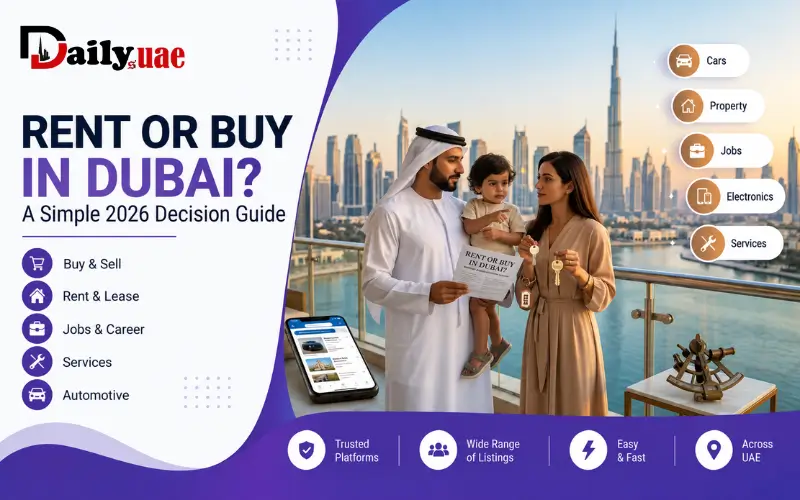
One of the most critical decisions in Dubai’s real estate and lifestyle is the choice of renting or buying. The property market has more options available than ever, ranging from flexible short-term rentals to long-term ownership plans with competitive mortgage rates in 2026. However, the “right” choice comes down to your budget, career security, family considerations, and length of stay.
The guide deconstructs all the essential elements in a simple, straightforward manner and helps you to make an informed decision without getting lost in the jargon or conflicting advice.
Why Does This Decision Matter More in 2026?
Dubai’s real estate landscape has evolved significantly. Car rental demand in Dubai remains strong in key areas, while new off-plan and ready properties continue to attract investors and end-users. At the same time, lifestyle expectations have shifted: many residents now prioritize flexibility, community amenities, and proximity to work and schools.
Choosing to rent or buy isn’t just about monthly costs; it’s about aligning your housing with your financial goals and life plans. A wrong decision can mean wasted money, missed opportunities, or unnecessary stress. A right decision can provide stability, equity growth, or the freedom to move when needed.
Renting in Dubai: Pros, Cons, and Ideal Scenarios
Pros of Renting
-
Flexibility
Renting offers you the liberty to relocate, downsize, or move to another area without the worry of selling a home. If you have a job and/or family situation that may change, this is particularly useful.
-
Lower Upfront Costs
Rentals usually call for a security deposit, which is usually 5% of the annual rent, plus agency fees, but no large deposit like a purchase. This frees up capital for other investments/expenses.
-
No Maintenance Responsibilities
Typically, the landlord is responsible for major repairs and maintenance in most rental agreements. This prevents any unnecessary expenses and inconvenience.
-
Premium Locations Accessibility
For areas that demand a lot of renters, such as Downtown Dubai, Dubai Marina, or Palm Jumeirah, it might be more practical to rent than buy for many.
Cons of Renting
-
No Equity Build-Up
Your monthly payments are actually aiding another individual’s asset. This can lead to missed opportunities to build wealth through the appreciation of properties over time.
-
Rent Increases
Dubai rents can go up when they are renewed, particularly in areas where there is high demand. There are regulations, but budgeting for possible increases is vital.
-
Limited Customization
Most landlords have guidelines that limit large renovations, so you may not be able to make your space exactly what you want it to be.
-
Uncertainty
The length of the lease is usually a year, and often the landlord decides to sell or not renew the lease.
Who Should Rent?
If you can afford to rent, this may be a better option:
- You will be staying in Dubai for less than 3-5 years.
- You don’t know if you will have a job or an income.
- You prefer to be flexible rather than stable.
- You prefer to invest your capital elsewhere (e.g., business, stocks, or other assets).
When speed is a priority, booking a home through a trusted site and classifieds can help you secure the ideal home. If you’re looking, you can post your Ads or check available rentals on GreatDubai.com/classified.
Buying in Dubai: Pros, Cons, and Ideal Scenarios
Pros of Buying
-
Equity and Asset Building
All mortgage payments create equity. This can accumulate over time and prove to be a valuable resource, particularly if property values rise.
-
Stability and Control
When you own, you have a long-term investment, and you can update, decorate, and alter your home to fit your needs.
-
Potential Rental Income
You can either rent the house once you move out and get some passive income, or sell the house for a profit.
-
Fixed Mortgage Payments
As opposed to rents that may go up, mortgage payments (particularly fixed-rate loans) are predictable, helping long-term financial planning.
Cons of Buying
-
High Upfront Costs
Buying requires a down payment (typically 20–25% for expats), plus DLD fees (4%), agency fees, and other closing costs.
-
Long-Term Commitment
Selling a property can take time, and market conditions may not always be favorable. This reduces flexibility compared to renting.
-
Maintenance Responsibility
As an owner, you’re responsible for all repairs, service charges, and upkeep costs.
-
Market Risk
Property values can fluctuate. While Dubai has shown strong growth in recent years, there’s no guarantee of continuous appreciation.
Who Should Buy?
Purchasing is frequently the superior alternative when:
- Your intention is to live in Dubai for 5+ years.
- You have a steady income and are able to pay the down payment amount.
- You’re looking to create stability and equity over time.
- You are familiar with the duties associated with being an owner.
If you’re considering buying a property, you can simplify the process by working with an agent who is reliable and trustworthy and by using a reliable platform. GreatDubai.com offers property listings and reaches sellers.
Key Factors to Consider Before Deciding
1. How Long Will You Stay?
The one and only question that is most important.
- Less than 3 years: More often than not, it will make sense to rent.
- 3 to 5 years: This will depend upon market conditions and your finances.
- Stable income: 5+ years, buying is usually more financially viable.
2. Total Cost Comparison
Do not compare monthly rent and mortgage. Consider:
- Renting: Annual rent, agency fees (5%), security deposit, potential rent increases.
- Buying: Down payment, mortgage interest, DLD fees (4%), service charges, maintenance, insurance.
Try to use online calculators or ask a financial advisor to create different scenarios.
3. Career and Income Stability
For those with stable employment and a long-term career in Dubai, purchasing can be a more appealing option. Renting is a safer option if you’re not set on a career path or if you may be moving.
4. Investment Goals
Do you want to accumulate equity or invest in other valuables? Others prefer to invest their money in a business or diversified investment portfolio rather than in real estate.
5. Lifestyle Preferences
Are you willing to have the freedom of moving around freely, or are you looking to have the stability of homeownership? Family needs, the location of schools, and community amenities also factor in.
Rent vs. Buy: A Simple 2026 Scenario Breakdown
Scenario 1: Young Professional on a 2-Year Contract
- Best choice: Renting.
- Why: Flexibility to move or relocate without being attached to a property. Reducing the initial expense means that it makes sense to save or invest elsewhere.
Scenario 2: Family Planning to Stay 7+ Years
- Best choice: Buying.
- How: A residence adapts to the needs of a family as it grows and then becomes more stable and secure.
Scenario 3: Investor Looking for Rental Yield
- Best choice: Buying (if cash flow and ROI calculations are positive).
- How: By renting out or selling the property for a profit.
Scenario 4: Entrepreneur with Uncertain Income
- Best choice: Renting.
- Why: Saves money for business expansion and doesn’t run the risk of not paying the mortgage if things get tight.
Common Mistakes to Avoid
1. Ignoring Hidden Costs
There are expenses besides just the monthly rent or mortgage that are associated with renting and owning a car. Consider charges, deposits, service charges, and maintenance.
2. Overextending Financially
Do not purchase a house that is “borderline” in terms of available funds. Have some contingency for fluctuations in market price and emergencies.
3. Focusing Only on Price
The location, community, and plans for future development are as important as the cost. It might be worth paying a little more for better quality in a better location.
4. Not Planning for Exit
Have a plan for exiting the lease or purchase, regardless of whether you’re renting or buying. What if there is a need for relocation, selling, or moving unexpectedly?
How GreatDubai Can Help You Decide
Navigating the rent vs. buy decision is easier with the right resources and platforms. GreatDubai.com serves as a trusted hub for property listings, market insights, and community-driven information.
How GreatDubai supports your decision:
- Property Listings: Browse both rental and sale properties across Dubai to compare options.
- Classified Ads: Connect directly with landlords, sellers, and agents through GreatDubai.com/classified.
- Market Insights: Stay updated on trends, new developments, and neighborhood guides to make informed choices.
- Community Trust: Benefit from a platform designed for UAE residents, with a focus on transparency and local relevance.
Whether you’re leaning toward renting for flexibility or buying for long-term stability, using a reliable platform like GreatDubai can simplify your search and connect you with verified opportunities.
Read More: Amazon UAE
Final Thoughts:
There’s no universal answer to whether you should rent or buy in Dubai. The optimal choice will depend on your lifestyle, your financial goals, and your personal situation.
Choose renting if:
- You like flexibility and mobility.
- You have a temporary residence, or you don’t know how long you will be staying.
- You want to avoid initial expenses and upkeep.
Choose buying if:
- You are looking to hold on to the property for a long period of time (5+ years).
- You wish to build up equity and stability.
- You have the financial means to take care of the duties of owning a business.
Do not rush; work the figures and factor in money and lifestyle. Once you’re looking around, be sure to take advantage of trusted platforms such as Great Dubai to search for homes, post your ads, or reach out to those who can help you with your next step.Dubai has some rental and buying options for 2026. The secret lies in choosing something that matches your objectives and then going for it with certainty and clarity.