




Modern luxury vehicles offer far more than just basic cooling; their climate control systems can simultaneously manage multiple temperature settings, fan speeds, airflow zones, and even the direction of the airflow.
When a malfunction occurs, the issue may not be as simple as low refrigerant levels or a dirty filter; various components—such as advanced sensors, control units, electric motors, and concealed air ducts—can all impact cabin comfort.
This highlights the importance of expert diagnostics: a trained technician can inspect the entire system to pinpoint the actual fault, thereby saving the customer from the unnecessary replacement of expensive air conditioning components.
How Specialist Diagnosis Identifies Advanced Climate Control Problems
1. Advanced Climate Control Systems Have Many Connected Parts
A modern climate control system consists of multiple components working in unison; the compressor, evaporator, condenser, fan motor, sensors, control unit, vents, and air flaps each perform distinct functions.
A malfunction in one component can affect the performance of another; for instance, a faulty temperature sensor might send incorrect data to the control unit, prompting it to alter the cooling level.
While identifying the cause of a malfunction may be straightforward in simple air conditioning systems, in luxury vehicles, it may require inspecting several components before the actual problem becomes apparent.
2. Electronic Sensors Control Cabin Temperature
Luxury vehicles often employ multiple sensors to measure both interior and exterior temperatures, enabling the climate control system to determine the required level of cooling.
Some systems can measure sunlight intensity, cabin temperature, ambient air temperature, and even the temperature in the immediate vicinity of individual passengers. If a sensor provides an inaccurate reading, the system may fail to cool the cabin correctly—for instance, by prematurely reducing cooling or continuing to operate when it is no longer necessary.
A technician can use diagnostic tools to compare sensor readings against actual conditions, helping to identify faults that might not be apparent during a standard visual inspection.
3. Multiple Climate Zones Make Diagnosis More Complex
Many luxury SUVs have dual-zone, tri-zone, or four-zone climate control. This allows people in different seats to choose their preferred temperature. While this feature improves comfort, it also adds more components to the system.
Each zone may have separate controls, air doors, sensors, and motors. If one zone becomes warm while another remains cold, the issue may be linked to one of these parts. Simply adding refrigerant may not solve the problem.
For drivers looking for the best car AC repair in Sharjah, choosing a workshop with proper diagnostic tools and trained technicians can make it easier to find zone-specific faults.
4. Faulty Blend Door Actuators Can Change Airflow
Blend door actuators are small electric motors that operate the doors within a vehicle’s HVAC system. These doors control airflow paths—directing air through either the warm or cold air channels—and are typically located in concealed areas behind the dashboard and other interior panels.
If an actuator fails, the door may remain stuck in the wrong position, causing warm air to blow from one vent while another operates normally. Drivers may also hear clicking sounds coming from behind the dashboard.
A professional inspection can verify actuator movement and control signals before any dashboard components are dismantled; this saves time and reduces the risk of replacing a part that is actually functioning correctly.
5. Diagnostic Scanners Help Find Electronic Faults
Modern climate control systems are linked to the vehicle’s electronic network; consequently, if a malfunction occurs in a sensor, actuator, or control unit, the system may store an error code. Professional diagnostic tools can read these codes and provide valuable information regarding the potential location of the issue.
However, the appearance of an error code does not necessarily mean the indicated component must be replaced; the code could point to a wiring issue, a poor connection, or another related fault.
Therefore, a qualified technician should use this code as a starting point to inspect the relevant electrical circuit, as this approach helps avoid unnecessary repairs.
6. Low Refrigerant Is Not Always the Main Problem
Low refrigerant levels are a common cause of poor air conditioner performance, but they are not the only possibility; technicians sometimes focus on refrigerant levels simply because the air blowing from the system feels warm.
However, complex climate control system malfunctions can also arise from issues with sensors, control units, airflow flaps, or compressor control systems. If refrigerant levels are low, a leak may be present and require attention; simply adding more refrigerant without locating and repairing the leak offers only a temporary fix.
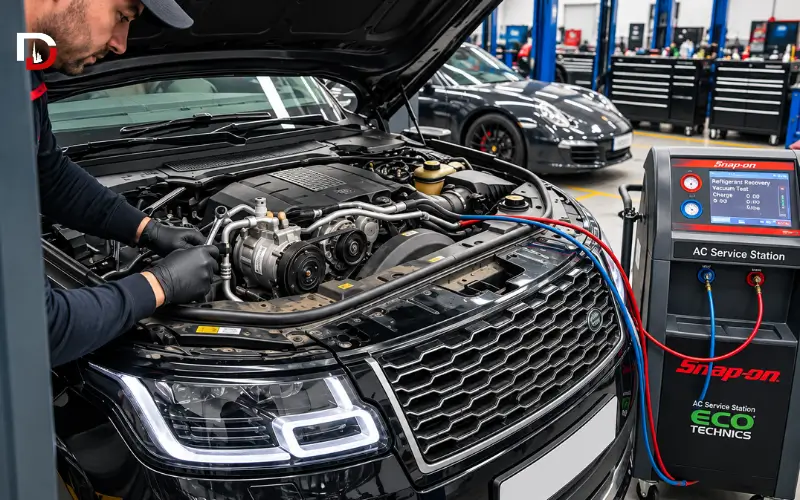
A professional diagnostic process involves checking system pressure, inspecting for leaks, and testing the cooling system as a whole, providing a clearer picture of why the air conditioner is not functioning correctly.
7. Compressor Problems Can Be Hard to Identify
The compressor is a critical component of the air conditioning system, responsible for circulating the refrigerant to remove heat from the vehicle’s cabin. In many modern luxury vehicles, the compressor is electronically controlled rather than relying on a simple on/off mechanism.
A compressor may continue to operate even when its performance efficiency has dropped, making it difficult to detect issues during a quick inspection. Therefore, a technician can evaluate pressure readings, the compressor’s operating mechanism, electrical signals, and cooling efficiency.
These tests help determine whether the fault lies with the compressor itself or if another component is preventing it from functioning correctly.
8. Software and Control Module Issues Can Affect Cooling
Climate control systems rely heavily on electronic control modules. These modules receive information from sensors and send commands to different parts of the HVAC system. A communication problem between modules can affect cooling, fan speed, temperature settings, or air distribution.
In some cases, the hardware may be working properly, but the control system may have a software or communication issue. This is one reason specialist diagnosis matters in newer vehicles.
Proper equipment can check communication faults and system data that cannot be seen through a basic AC inspection. The technician can then decide whether the problem is mechanical, electrical, or software-related.
9. Wiring Problems Can Create Strange AC Symptoms
Electrical wiring connects sensors, motors, switches, and control modules throughout the vehicle. A damaged wire, loose connection, or corroded terminal can stop a working component from receiving the correct signal.
Electrical faults can also create symptoms that appear unrelated to the actual problem. For example, a temperature sensor may work correctly, but a damaged wire may prevent its reading from reaching the control module.
Replacing the sensor would not fix the issue. A specialist can test voltage, resistance, connections, and communication lines to locate the real source of the fault.
10. Hidden Air Duct Problems Can Reduce Cooling
Air ducts in luxury vehicles channel cooled air to various parts of the cabin. Since these ducts are concealed behind interior panels, issues affecting them can be difficult to detect; a loose connection or a damaged duct can cause cold air to leak before it reaches the intended vent.
This can result in passengers experiencing uneven temperatures within the cabin—for instance, rear-seat passengers might notice weak airflow even if the front vents are functioning normally.
A specialist can inspect airflow across different zones and examine the HVAC system as needed; early detection helps avoid unnecessary repairs to other components of the air conditioning system.
When Should You Have the Climate System Checked?
Drivers should not wait until the AC completely stops working before arranging a diagnosis. Small changes can be early signs of a developing problem. Uneven cooling, weak airflow, unusual sounds, or temperature changes between zones should be taken seriously.
It is a good idea to have the system checked when:
- One climate zone stays warmer than another.
- Cooling becomes weaker than normal.
- The fan speed changes without input.
- Air comes from the wrong vents.
- The dashboard makes clicking or buzzing sounds.
- The AC takes too long to cool the cabin.
- Temperature settings do not match the actual cabin temperature.
Early diagnosis can often prevent a small fault from causing further damage to other parts.
Read More: Amazon UAE
Conclusion
Advanced climate control systems offer superior comfort, but their complex design makes diagnosing faults more challenging. Sensors, actuators, control units, wiring, air ducts, compressors, and cooling systems can all impact cabin cooling.
A simple inspection may not always reveal the root cause. Specialized diagnostics employ appropriate testing equipment and a precise process to pinpoint the fault before any parts are replaced.
If your luxury vehicle is experiencing uneven cooling, weak airflow, or climate control malfunctions, an early system inspection helps restore comfort and prevents a minor issue from escalating into a major breakdown.